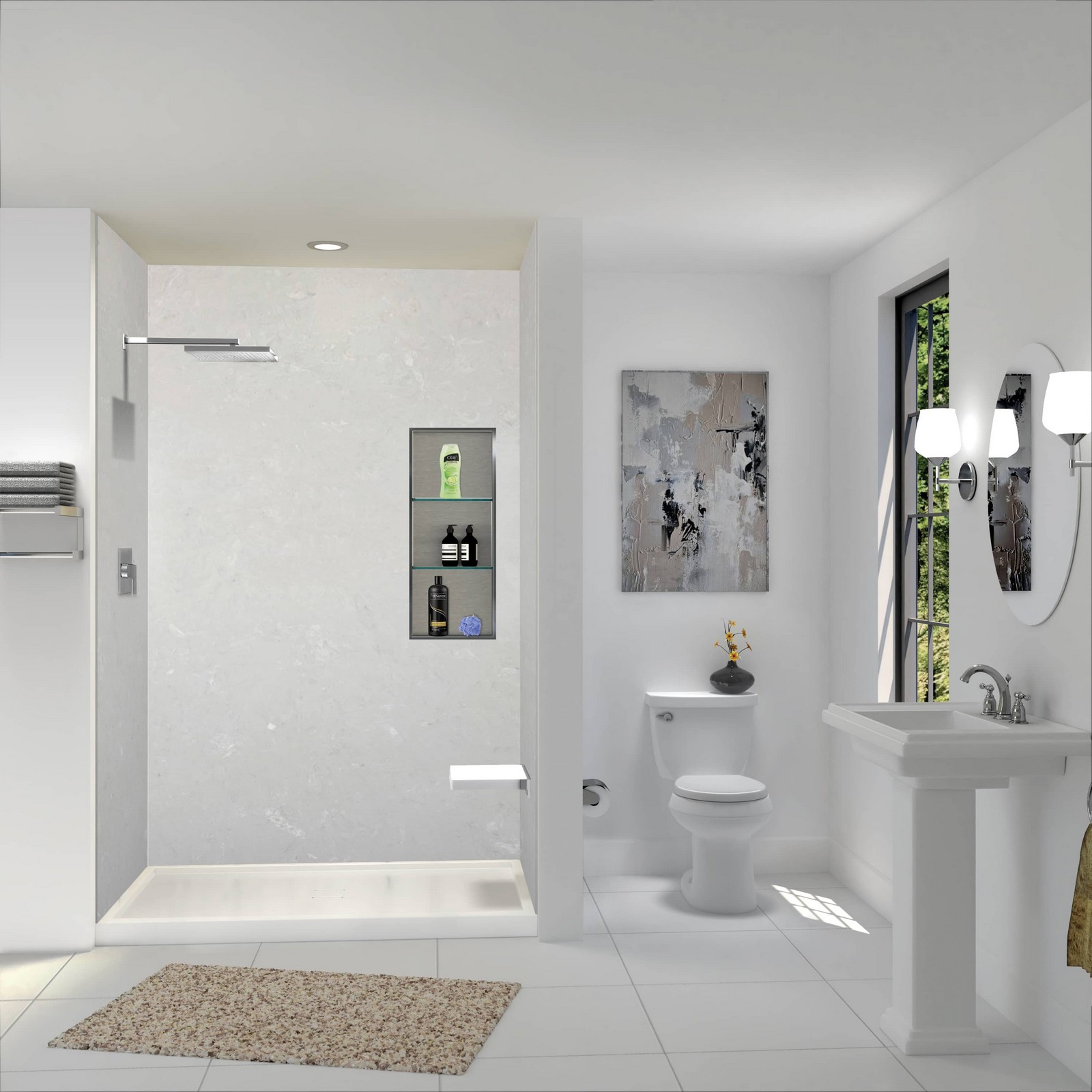
Most people have never watched a shower being replaced, so the process is a black box. Here is what actually happens, in order.
The measurement visit
Nothing can be fabricated until someone has measured your alcove properly, including whether the walls are square, which in an older Plainfield home they frequently are not. This visit is also when you choose colours, pattern, fittings and shelf positions.
Fabrication
Your panels, pan and shelving are then made to those dimensions. This is the part that takes the calendar time, and it is also the part that makes the installation itself so quick. Nothing is being improvised on your bathroom floor.
Tear-out
On installation day the old surround and pan come out, and this is where a competent crew earns its money. What is behind a failing shower is often worse than what is in front of it, and finding soft substrate or a slow leak in a joist is not unusual.
Fitting and sealing
The pan is set and levelled first, then the wall panels, then the trim and fittings. Sealing is the last and most important step, and it is the step that gets rushed on a cheap job.
Cleanup
A proper crew leaves with the debris. You should not be discovering old tile in your garden a week later.
How to compare quotes
Two quotes for the same shower can differ by thousands, and the difference is rarely the panel. Ask what happens if they find rot. Ask who the installers work for. Ask what the warranty covers and for how long. A quote that cannot answer those is not the cheaper option, it is the riskier one.